The Age of Taste
On taste-centrism: why personal aesthetic sensibility has become the defining currency of the content economy.
On Taste-Centrism
#The Age of Taste
Will this land?
When making content, I often find myself asking "will this work?" Content takes a long time to produce, but once finished, distribution and feedback happen almost in real time — you submit the answer sheet and receive the grade almost immediately.
So naturally, planning is always done with "reader response" in mind. But given the nature of a newsroom — where most projects are short-cycle — there's rarely enough time for precise user analysis or sampling. (To be honest, I don't know the analysis methods or pre-survey techniques anyway. I'm in charge of planning but don't really know how to "plan" in a rigorous sense.)
Most of the time, a project moves forward based on instinct — a feeling of "I think this will work."
The more you repeat the process, the more that instinct slowly sharpens and the hit rate goes up a little — but of course, it misses far more often than not.
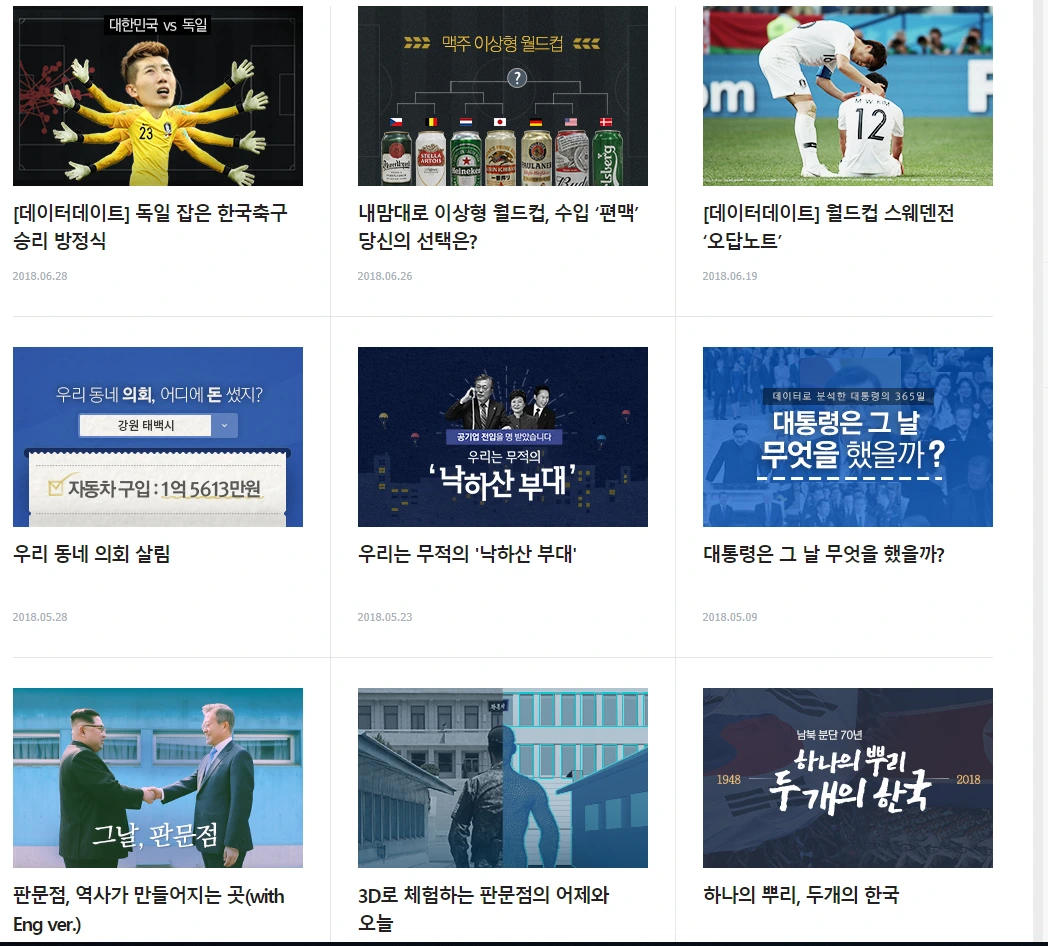 Content I mostly work on: http://news.joins.com/digitalspecial/list
Making content about North Korea one day, elections the next, and beer the day after that — sustaining readers' interest is not easy. Projects also don't happen every day, and news that misses the right moment loses its news value fast — so the timing battle is also something I keep learning and relearning. (And these readers came to read "news" — it's a bit like being sentenced to sell ramen to people who walked into a bookstore...)
Still, whatever faint instinct I have says: readers' interests are increasingly fragmenting.
For now, Naver's influence means that mainstream readers still consume content according to Naver's curation choices (Naver is still king in text-based content). Articles on the front page easily hit 500,000 to 600,000 views.
But reader interests are gradually diversifying and fragmenting. There are several reasons, but let me mention two.
1. The influence of Facebook, Instagram, and other social media
SNS is a social network service. The key word is network — the content you encounter on SNS is mostly what's being shared within your personal network of friends, acquaintances, and neighbors. In my case, I've built a network largely around people who share content I find interesting, so naturally the content that appears in my feed aligns with my interests — deepening and narrowing them over time. This is the filter bubble effect. (A lot of media discusses filter bubbles negatively, but for curating through the lens of taste preference groups, this kind of filter is actually quite effective at handling information overload.)
2. The development of AI.
This isn't a grand claim — it's just the machine learning effect. Continuously curating parenting content to a consumer who has no children is meaningless. Suggesting content matched to consumption patterns has become the obvious norm. Learning users' patterns and recommending personalized content is exactly what diversifies and deepens readers' interests.
#Hapjeong Taste Hall
Let me take a detour here. Until last year I lived in Mangwon-dong, Mapo-gu, and I loved watching the alley transform day by day. Not because hip new shops were opening (not that they were my own), but because I was fascinated watching a formerly characterless street become a place full of different personalities.
Recently I heard about a place called "Taste Hall" (취향관) that a colleague's acquaintance opened in Hapjeong. There was a team seminar before opening that I couldn't make it to. (But I've heard so much about it that I feel like I have been.)
To quote from one article... (excerpt) The Hapjeong "Taste Hall" aims to recreate the French salon culture of reflection and conversation. It attracts those who are tired of online platforms.
<Related article: "We need conversation" — the salon culture making a comeback: http://news.joins.com/article/22746947 >
An interesting trend.
Taste (취향, 趣向) is a peculiar word. In Chinese characters it means "the direction or tendency toward something one wants to pursue" — in English it translates roughly as taste or preference. People with matching tastes gravitating toward each other — what does that bring to mind?
For someone my age, the first thing that comes to mind is a "club" or "hobbyist group" (동호회). The word 동호 (同好) means "sharing a common liking for something" — so what's the difference between a hobbyist group and a taste hall?
I have a gut feeling that the gap between them is significant.
A hobby group is a categorized interest.
Taste is closer to a segmented direction — your personal orientation toward something specific.
The difference is this: a hobby group is primarily about bringing together people who share a broad common interest and providing mutual reassurance and networking. Taste, by contrast, prioritizes the individual's orientation toward a more fragmented, specific interest.
For example: I love science fiction novels, but I have no interest in a general SF club. Part of this is about the presence or absence of organized gatherings, but taste is also at play — I'm not that interested in other people; what matters is that I enjoy it. Specifically, I love Ted Chiang's work — but even within his catalog I have favorites and ones I don't connect with. I love SF, and I also love the Marvel Cinematic Universe, have an early-adopter streak, love the Romance of the Three Kingdoms and history, and follow specific EPL teams. That's my "taste."
From a taste perspective, broad-category classification feels limiting. Look at Naver News: Political / Economy / Social / Culture & Lifestyle / World / IT & Science. (Our company's departmental structure is roughly the same.) But taste can't really live inside those categories. If I want to consume SF content, do I go to "science"? Or "literature"? Or join an SF forum and answer "how did you find us?"
YouTube is smart because it has no categories.
YouTube curates video content on the home page based on your past viewing history, and shows you only what you subscribe to. What makes Instagram clever is that a single hashtag (#) lets you intuitively browse images that match your taste.
Before this gets too long, let me pull it together.
The reason I'm talking about taste is that I've noticed "taste"-centered consumption and marketing growing increasingly visible not just in online content, but offline as well.
The sociologist Pierre Bourdieu wrote in Distinction: "Taste classifies, and it classifies the classifier." The current prominence of taste signals a sharpening of social stratification.
It's not just wanting a "different" experience — it's wanting an experience that distinguishes. (I want to talk about the rediscovery of individuality here, but I'll hold myself back...)
And the emergence of a class with developed taste also signals the creation of a market that will open its wallet.
Taste-centrism.
As a content producer, that may be the point to pay attention to right now. If the mainstream spends 1 won and the niche spends 1,000 won, wouldn't 10 niche fans be better than 10,000 indifferent mainstream readers? (1 × 10,000 = 1,000 × 10, but factoring in management costs, 10 fans beat 10,000 indifferent strangers.)
Alright — back to figuring out what to make next.