Dajayo's Sinpung Vine House — Jeju Stone Walls and Snails: A Great Family Getaway
A stay at the lush vine-covered stone wall house in Sinpung, Jeju — the Sinpung Vine House. This is that story.
Dajayo's Sinpung Vine House — Jeju Stone Walls and Snails: A Great Family Getaway
The lush vine-covered stone wall house in Sinpung, Jeju, that I visited last year.
This is the story of #SinpungVineHouse.
After leaving my job, I'd been traveling around Jeju with my family and had long wanted to stay at a #Dajayo property — so I made a reservation. Looking back now, it was a decision I have no regrets about.
1. Dajayo DAZAYO
First, let me tell you about Dajayo.
Dajayo is a startup. That framing might sound a bit odd, but it's a company that revives vacant rural homes through renovation and transforms them into local tourism accommodations.
Here's their website for reference: https://dazayo.com/# (I wasn't paid for this. The founder is a Facebook friend of mine, though.)
Dazayo
They renovate vacant homes into upscale private guesthouses. The vacant house revival process: Step 1 — receive a referral, arrange rent-free use or purchase; Step 2 — secure funding; Step 3 — renovate; Step 4 — operate as a stay and explore other uses.
As urbanization progressed, rural areas were left with growing numbers of abandoned homes — a serious headache. Dajayo stepped in to address that mismatch.
It was around 2015 or 2016 when I first heard their story. The concept clicked for me immediately.
Of course, I had questions: Would tourists actually travel to remote rural villages far from major cities? How is this different from just developing a standard pension? But the Dajayo story I encountered through various media coverage was far more sincere than a typical resort developer, and from that point on I became a quiet supporter.
Those familiar with the startup world probably know the Dajayo story already.
Just as the ride-hailing service Tada was doing well before suddenly hitting the wall of the "Tada Ban Act" and collapsing (interpretation varies), Dajayo was also growing when it was flagged for violating the Rural Area Development Act in 2019, bringing the business to the brink of failure.
But within a year and three months, the government's conflict mediation model (the "One Step Model") allowed it to revive, and it currently operates under a proof-of-concept special exception.
In my case, knowing how Dajayo had grown — how it had been celebrated and then suddenly branded a lawbreaking startup — and knowing it had weathered that period and resumed operations, I arrived with enormous anticipation even before stepping through the door.
If you're curious about the Dajayo story, you can search for articles. Here's one link: https://www.hani.co.kr/arti/economy/it/999207.html
The Jeju Vacant Home Revival Startup... The Joys and Sorrows of Dajayo's Nam Sung-jun
[Choi Min-young's Innovation Living] (https://www.hani.co.kr/arti/economy/it/999207.html)
2. Arrival: Sinpung Vine House
I had hoped to spend most of the ten-plus-day trip staying at various Dajayo houses across Jeju, but many popular options were fully booked, and the routes didn't line up perfectly — so I had to settle for the Sinpung Vine House.
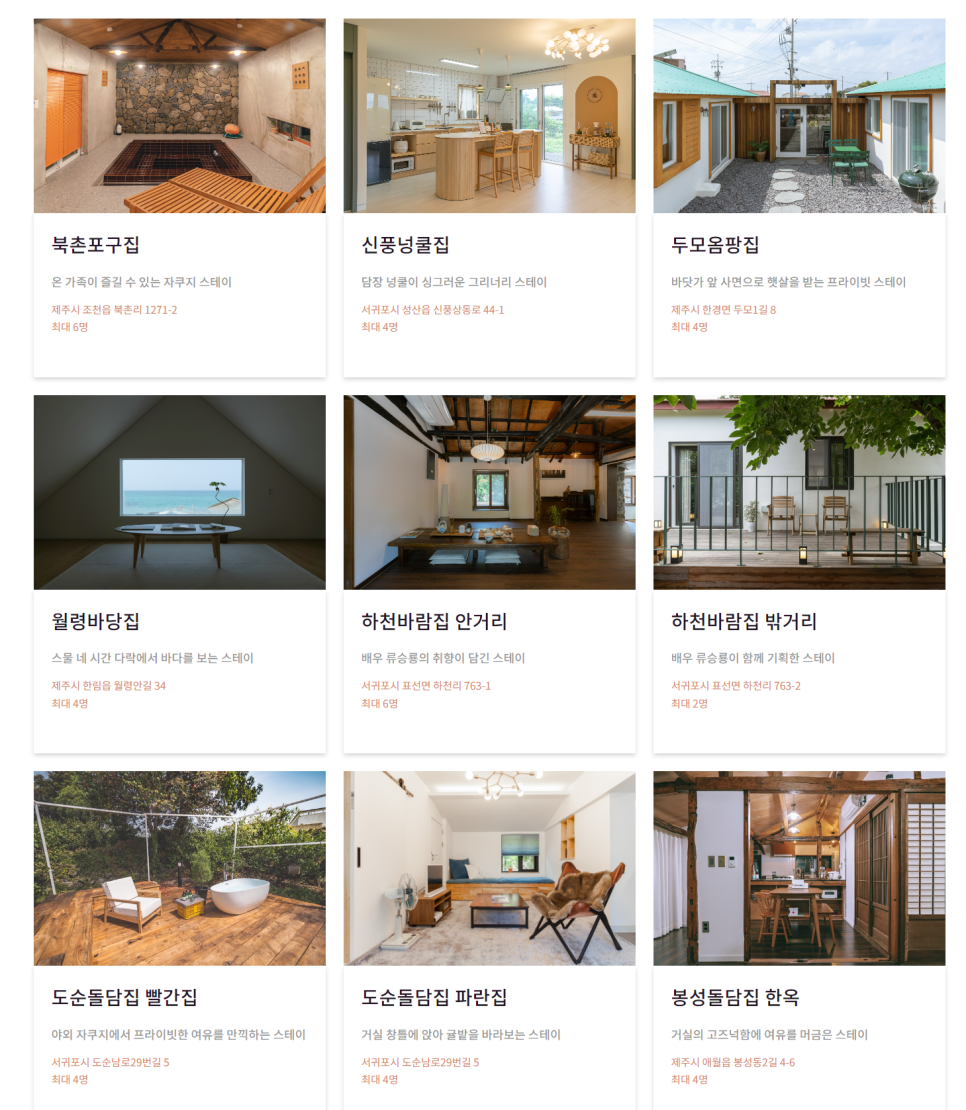
Dajayo has many charming properties through its vacant home revival program.
It felt slightly inconvenient to head to the southeastern corner of the island near Seongsan Ilchulbong toward the end of the trip, but I wanted to spend two nights relaxing in one place — and the Sinpung Vine House, described as sitting quietly within a real neighborhood, seemed like the right choice.
Sinpung Vine House
44 Sinpungseongdong-ro, Seogwipo-si, Jeju Special Self-Governing Province
Looking at the map, it's genuinely nestled inside a village. Even driving there I wondered whether there could really be a guesthouse in this direction. Once we arrived, I remembered that the nearest grocery store was quite a drive away. We ended up shopping at a place called Jeju-in Food Ingredients Mart in Pyoseon, about 10 minutes away — spacious and easy to park, well worth visiting if you're staying nearby.
Jeju-in Food Ingredients Mart
6 Pyoseon-jungang-ro, Pyoseon-myeon, Seogwipo-si, Jeju Special Self-Governing Province
The photo below, taken from the front of the Sinpung Vine House looking out at the road — it's just the countryside, as you can see. Quiet, perfect for unwinding. The road is well-maintained and easy to drive on, with a custom stone-wall parking area right beside the house. There's also an alternate entrance from the other side, with an even more rustic paddy field view.
Either way, arriving there didn't feel like coming to a tourist destination. It felt more like visiting a country grandmother's house — one that had been cleaned spotlessly.
The day we arrived was overcast, cold, and drizzling on and off. I was slightly deflated at the thought of unloading luggage in the rain, but the combination of the orange gate and the blue roof visible behind it immediately lifted my spirits.
The gate is an iron door — very much the feel of opening a country grandmother's front gate.
This is the layout of the property. [From the Dajayo website]
Many visitors to Jeju long to stay in a house with stone walls, and this place delivers — the stone walls here are genuinely charming. This style of wall is called "jibdam" (house wall), and since it's built in a single row, it's also an "oedam" (single-layer wall).
In Jeju, beyond the house wall, you'll find "olledam" (alley walls leading to gates), "batdam" (field walls), "wondam" (coastal walls), "seongdam" (fortress walls), "gaegyeongdam" (wave barriers), and "sandam" (tomb walls). With Jeju's strong winds, wall-building became an art form. As you can see, the volcanic basalt is stacked with deliberate gaps to let wind pass through — which is why they stand up even in typhoons.
The photo below was taken in the courtyard on the second day, after the weather cleared. Look at how charming that orange gate is against the stone wall. The house has no immediate neighbors on either side, giving it a peaceful feel.
Positioned at the edge of the village on slightly elevated ground, it has a #private quality — hard for passersby to peer in unless they make a deliberate effort.
Here's a front view of the Sinpung Vine House with orange tangerine trees in the yard.
3. Sinpung Vine House: Dajayo's Warmly Intrusive Touch
The first impression stepping inside was tidiness.
It's a different kind of tidiness from a luxury hotel — more like a well-kept home where everything you'd need for daily living is in place, organized thoughtfully, positioned where you'd naturally look for it.
And yet it wasn't overdone — small decorative touches and little moments of wit placed here and there added warmth. The plant decor is a perfect example.
Plantscaping is clearly trending — and it shows.
My wife also admired the kitchen tools and wanted to take them home. I don't remember the exact product names, but she mentioned the brand and said it was a quality item.
The kitchen tools.
The refrigerator was generously sized, and the glassware and dishes were well-stocked. Staying for multiple nights or doing a #JejuLongStay would be comfortable — you wouldn't want for anything. A functional kitchen matters enormously on #familytrips.
Even if you eat out most of the time, the trend toward "a month in Jeju" means having a home-like environment really counts. A poorly equipped kitchen raises doubts about the cleanliness of everything else.
Various amenities from Jeju startups.
The amenities.
Dajayo is something of a godfather to the #JejuStartup scene, so it's well-connected with local companies and entrepreneurs. The founder makes a point of providing amenities using locally-made Jeju products, so guests get to experience Jeju-based goods.
You'll find things like Jeju pork jerky and Jeju barley rice cakes — products with strong local character, packaged and marketed in a contemporary way. Mutual support, symbiosis.
A tablet with a PDF guide to the property is also provided.
Rather than just leaving items in a basket, they walk you through everything via tablet. After the usage guide for the Sinpung Vine House, you get an explanation of each amenity — who made it, what philosophy guided it, and where you can purchase it if you'd like. Thoughtful and thorough.
4. A Tour of the Interior
The living area receives good natural light and is designed as a standing space. The long table connected directly to the kitchen is the heart of it.
It's a bit high for young children, but the table is wide enough to do many things together.
My wife brightened up at the sight of the washing machine. We'd been traveling for quite a while and had done coin laundry once at a resort midway through — but when she spotted the machine, she delivered the immortal line: "A proper guesthouse has a washing machine."
Coffee-making equipment was arranged on the right side. Having once ground my share of coffee beans — even tried kopi luwak — I took advantage of the supplied beans the next morning and brewed a cup.
Coffee tools.
Inside, beyond the living room, there are 2 bedrooms and 2 bathrooms/toilets — one connected to the living room and one connected to the master bedroom.
The master bedroom has a king-size bed, and the bedding exceeded expectations.
Master bedroom king bed.
The bathroom off the master bedroom has a large bathtub — useful on the rainy first night when we couldn't use the outdoor jacuzzi. The amenities were high quality, and the wooden armrests on the bathtub were a lovely touch.
Master bedroom bathroom.
The other bedroom has two single beds and a portable TV. It opens directly to the outdoor deck and jacuzzi. My son and I slept there, and I ceded the king bed to my wife.
Small bedroom — the portable TV was handy, and we moved it into the living room to watch.
5. Outdoor Charcoal Grill — The Joy of the Courtyard
Even though it rained on the first evening, it let up enough by dinner time for us to grill the meat we'd bought. The nearby mart (mentioned above, the Jeju-in Food Ingredients Mart) has excellent cuts.
The courtyard has a grill, and the kitchen is stocked with charcoal — anyone with a bit of camping experience will have no trouble getting a fire going and grilling a proper meal.
Meat is always the right answer.
On the clear second day, the grill looked like this. Heavy, but easy to clean and move around — a great item to have if you live in a house with a courtyard.
Calling this one for myself...
6. The Main Attraction: The Jacuzzi
The signature of the Sinpung Vine House is the outdoor jacuzzi in the courtyard, flanked by #green vines. You'll find plenty of photos of this on Instagram.
The combination of green vines, orange, white, and the Jeju sky is genuinely well-composed.
The walls are tall enough that you can enjoy the jacuzzi privately without worrying about passersby.
The hot water worked perfectly, and my son enjoyed it enthusiastically — though somehow the photos came out looking like he was in distress.
Using the jacuzzi, you're right next to the stone wall — the green is vibrant. A little rain had fallen, so everything looked fresh and dewy.
A #snail had also ventured out for a stroll.
As I mentioned earlier, this house had been vacant for over ten years — which is why the vines have completely covered the stone wall, giving the place an even more #naturefriendly feel.
The vines are wonderfully lush.
7. The Memory of Grandmother's House — Dajayo
Dajayo's motto is "a company that adds value to empty spaces."
The view beyond the stone wall.
Not a touristy, slightly hectic destination —
but an empty house in the middle of a real neighborhood, transformed into your own space.
No convenience store nearby, no café without a car ride —
but if you want to feel the Jeju stone walls,
feel the Jeju wind,
and experience Jeju life as it actually is,
this is a place I'd recommend spending some time.
It's rekindled my old thought of one day renovating a rural grandmother's house into something like this.
Thank you for reading.